The Temporal Architecture of Cognition: A Dual Axis Framework for Human and Synthetic Meaning
DOI: 10.5281/ZENODO.18279249
Modern institutions optimise for procedural speed.
Human
knowledge develops through temporal depth.
The Equilibrium Ledger reconciles this
structural asymmetry.
The ledger sustains collective memory, calibrates trust in institutional time, and provides a precise apparatus for worldbuilding. Every datum is indexed, every decision is accountable, and every reader is invited into rigorous, diplomatic contemplation.

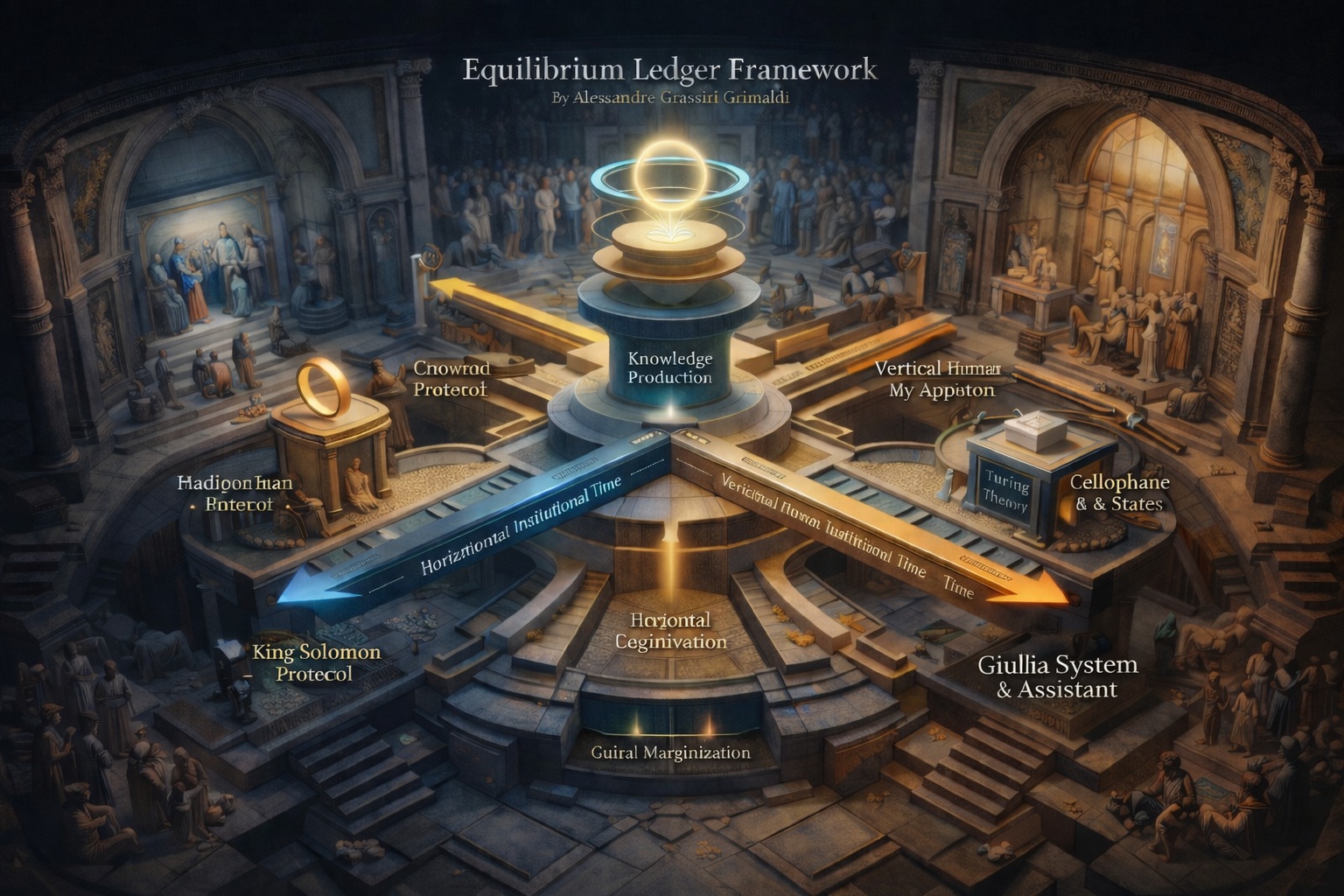
The Equilibrium Ledger Research centre operates as a compact academic atelier that blends museum grade restraint with engineered clarity, tracing how institutions stress time while human knowledge accrues depth.
We pair independent, transdisciplinary inquiry with public facing artifacts so that partners, policy leaders, and academics can map procedural velocity to sustainable governance without losing sight of epistemic accessibility.
The Equilibrium Ledger runs on two axes, a procedural axis charting governmental velocity and automation, and a temporal axis registering the accrued depth of knowledge, care, and lived experience. Each ledger entry captures metadata about governance, epistemic accessibility, and the synthetic systems it monitors.
Explore the framework and stay grounded with the curated reading pathway, sustainable governance requires that the ledger remain a living distribution of time.
Core architecture
DOI: 10.5281/ZENODO.18279249
DOI: 10.5281/ZENODO.18280342
DOI: 10.5281/ZENODO.18274550
DOI: 10.5281/ZENODO.18274451
DOI: 10.5281/ZENODO.18131673
DOI: 10.5281/ZENODO.18274660
DOI: 10.5281/ZENODO.18274325
DOI: 10.5281/ZENODO.18274512
DOI: 10.5281/ZENODO.18125735
DOI: 10.5281/ZENODO.18444616
DOI: 10.5281/ZENODO.18374368
DOI: 10.5281/ZENODO.18373882
DOI: 10.5281/ZENODO.18370265
DOI: 10.5281/ZENODO.18419725
DOI: 10.5281/ZENODO.18378014
Selected publications
A Doctoral Thesis Proposal and Working Paper, with Preliminary Empirical Evidence
Framework for human led supervision of multi model arbitration loops.
Neurodivergent cognitive architecture and the containment problem inside elite universities.
Critique of how institutional velocity mismatches disable knowledge flows.
Conceptual thought under synthetic calculation pressure.
View the full archive in the Zenodo Community.
Canonical reading pathway
A long form literary descent through memory, power, and cultural aftermath.
Est. 27 minA visual lineage reading of art history as institutional time, disappearance, and return.
Est. 18 minThe School of Athens as a visual proto model for the ledger's architecture of knowledge production.
Est. 22 minThere are moments in history that feel singular, catastrophic, transformative, or triumphant. Yet when observed across centuries, those moments begin to reveal something quieter and far more unsettling. Human behaviour rarely changes as much as we believe it does. Power isolates, societies oscillate between justice and fear, and individuals are often remembered not as they lived, but as history finds it convenient to preserve them.
My work exists within that tension. I write at the intersection of history, psychology, anthropology, and institutional analysis. I am less interested in heroic myth or moral condemnation, and more interested in understanding how individuals and societies behave when placed under pressure. Across different genres, historical narrative, memoir, and speculative fiction, my writing follows one method, observe the pattern, listen to the silence history leaves behind, and reconstruct the human truth that often disappears between official accounts and cultural memory.
This section introduces three long form manuscripts that represent three different trajectories of the same intellectual journey. Each work explores human behaviour from a different lens, historical descent, personal survival, and speculative projection, yet all are connected by a single question, how do societies and individuals repeat patterns they believe they have already escaped.

Men and Women Who Shaped Their Destiny and Ruled Their Century, Yet Time Interrupts All That Is Mortal
This manuscript is a Dantean journey through Naples and the great figures of European history. Guided symbolically by Virgil and Leopardi, the narrator encounters individuals who shaped their century yet were often misunderstood, reduced, or misrepresented by the historical record that followed them. Naples, with its layered memory, becomes both setting and metaphor, a city where past and present coexist in constant dialogue.
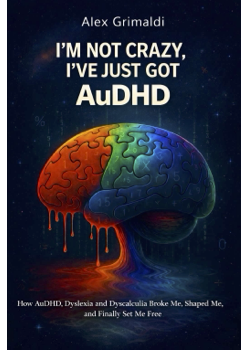
How ADHD, Dyslexia and Dyscalculia Broke Me, Shaped Me, and Finally Told Me the Truth
This is a personal yet structurally analytical memoir exploring life lived through undiagnosed neurodivergence. It follows masking, misinterpretation, overperformance, burnout, and eventual clarity. Diagnosis becomes not an endpoint, but a language through which decades of experience finally acquire coherence.
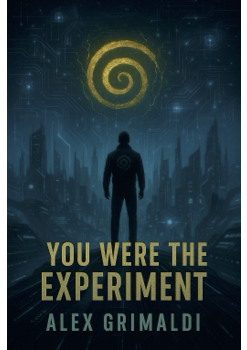
Speculative fiction on memory, loops, and emotional autonomy
This narrative explores the boundary between humanity and systems designed to observe, catalogue, and control it. The protagonist wakes in a world that appears familiar yet behaves according to invisible loops and manipulated memory. Emotion becomes resistance, and memory becomes a political and existential act.
Although these manuscripts move across different genres and narrative techniques, they share a single foundation. Each examines the relationship between individuals and the systems that shape, protect, distort, or erase them. Each asks whether societies truly evolve, or whether they simply redesign the language through which the same human conflicts reappear.
As a neurodivergent autistic observer, I do not sit in judgement of society. I sit in meticulous observation, dissecting behaviour and institutions until their patterns speak. I am not interested in blame. I am interested in patterns, in listening, in documenting, and in allowing those patterns to reveal what endures and what collapses.
History has always been the harshest judge. Rarely fair, never forgetful.
Founded by Alessandro in honour of his mother, Giulia. The trust centres neurodivergent people and their families as they navigate modern institutional bureaucracy with clarity, protection, and humane process design.
One to one guidance through forms, appointments, and timelines.
Plain language templates and checklists for critical submissions.
Institutional briefings and practitioner workshops grounded in the Equilibrium Ledger.
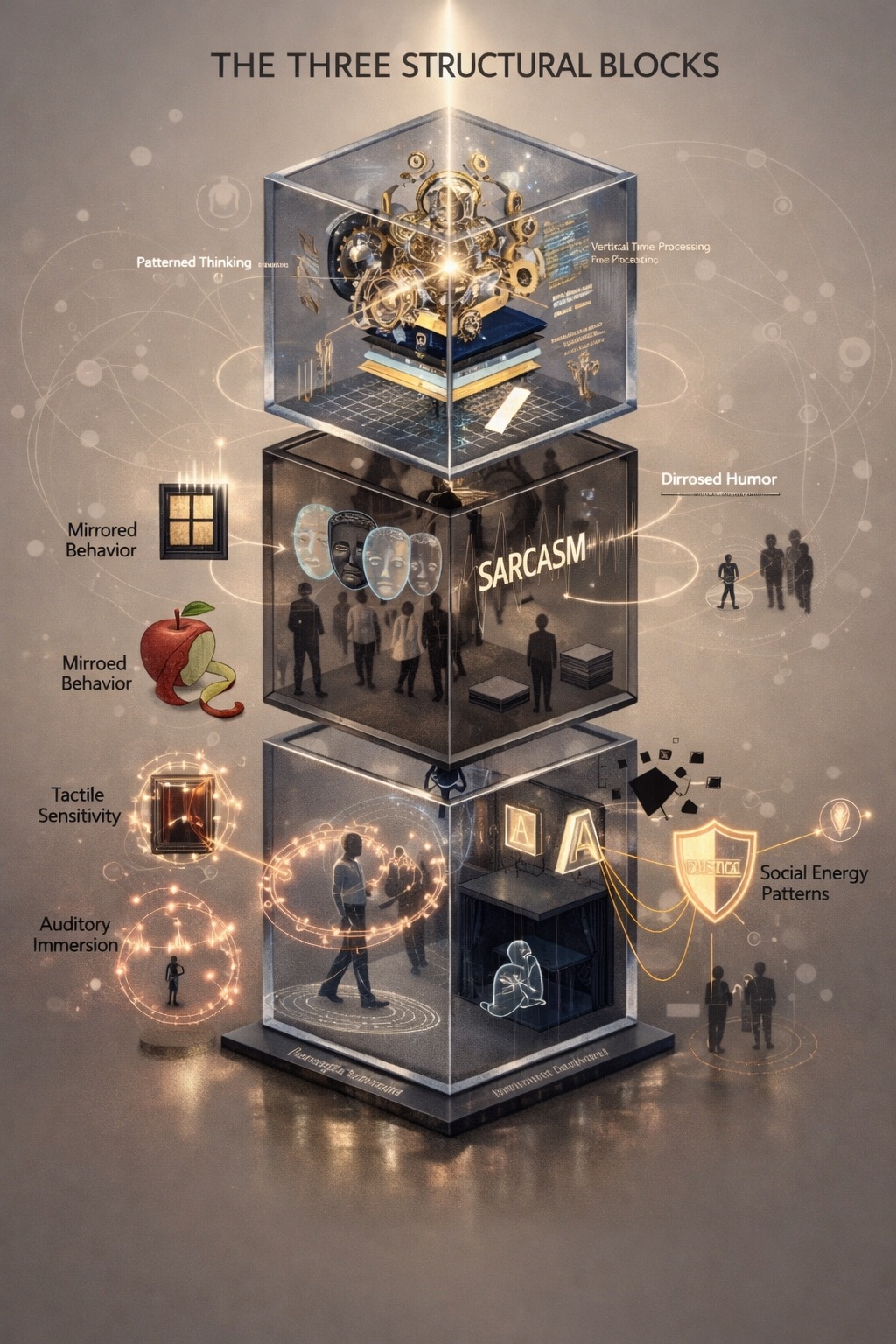


Short form audio essays voiced by Alex and Giulia. Each episode maps one artefact written by Alessandro Grassini Grimaldi, translated into lived navigation.
Micro essays, case studies, and field notes from the ledger.
Audio, transcripts, and structured summaries for accessibility.
Spotify, YouTube, and on page listening with a simple episode tile.